
The Alvars: Divine Poets and the Dravida Veda 🌸
The history and compositions of the Alvars represent a pivotal moment in spiritual history, where complex Vedic philosophy was transformed into accessible, soul-stirring Tamil poetry.
The Prophecy: Srimad Bhagavatam and the Southern Saints 🔮
The origins of the Alvars are rooted in a prophecy found within the Srimad Bhagavatam (Bhagavata Mahapurana). This prophecy appears during a conversation between Parikshit, the son of Abhimanyu, and Shuka Brahma, the son of Vyasa. Shuka reassures Parikshit that the lineage of devotees of Hari (Vishnu) has not ended but will flourish in the future.
The specific prophecy is encapsulated in the verse: "Kwachit kwachin mahabhaga dramideshu cha bhurishah". Shuka predicts that great devotees will be born in the Dramida (Dravida) land, referring to peninsular India. Historical context suggests a significant time gap between the prophecy and its fulfillment; while the Mahabharata era is dated around 3136 BCE, this prophecy—delivered around 3050 BCE—foretold events that would manifest nearly 3,000 years later, between the 6th and 9th centuries AD.
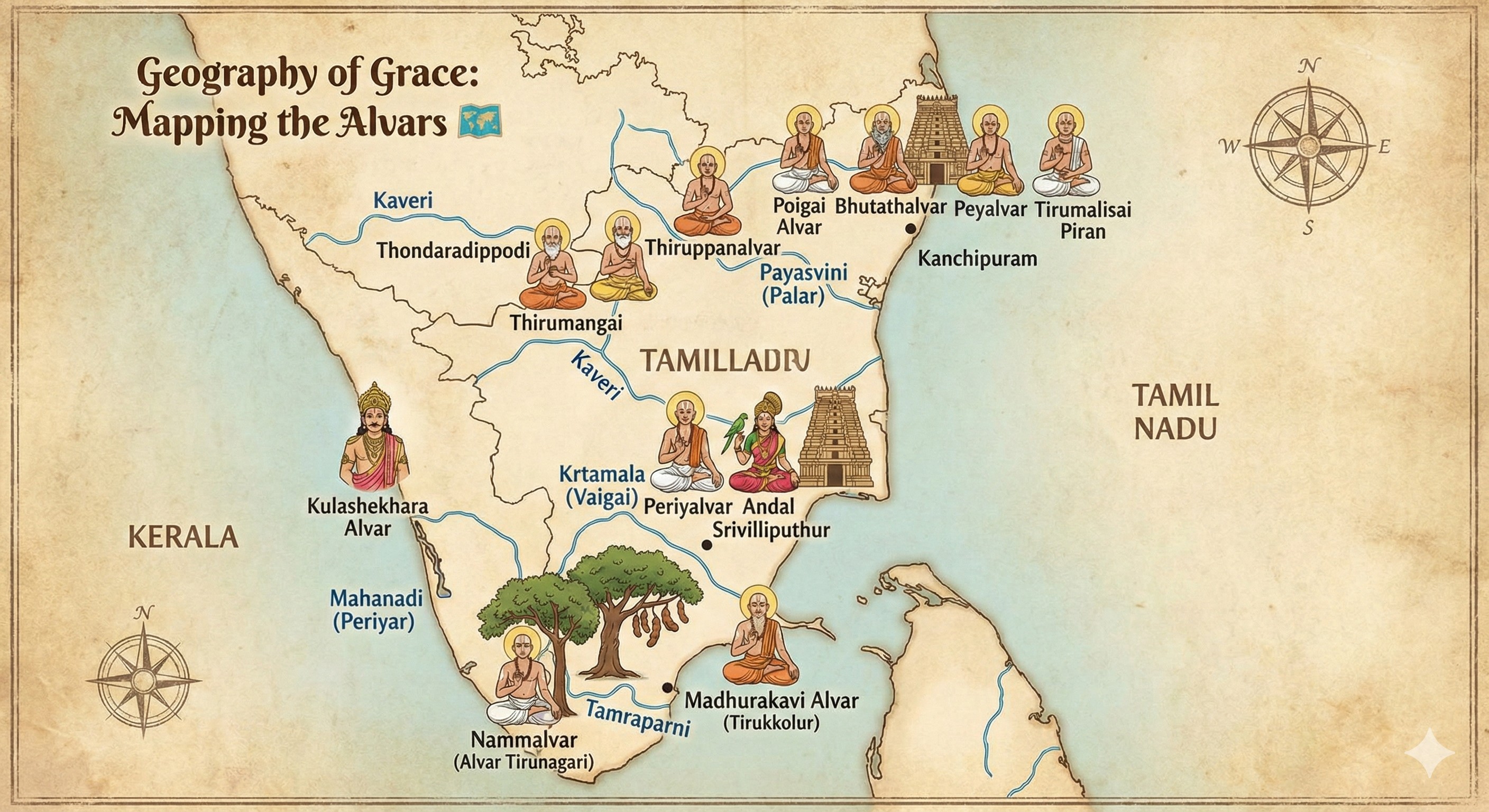
Geography of Grace: Mapping the Alvars 🗺️
The Bhagavatam provides specific geographic coordinates for the appearance of these saints by listing the rivers on whose banks they would be born. The 12 Alvars are mapped to these rivers as follows:
- Tamraparni River: Located south of Madurai in Tirunelveli. The prophecy links this river to Nammalvar (born in Alvar Tirunagari) and Madhurakavi Alvar (born in Tirukkolur).
- Krtamala River: Identified as the Vaigai River in Madurai. Two saints, Periyalvar and Andal, appeared near this river in the temple town of Srivilliputhur.
- Payasvini River: Identified as the Palar River, flowing near Kanchipuram and Chengalpattu. This region is associated with Poigai Alvar, Bhutathalvar, Peyalvar, and Tirumalisai Piran.
- Kaveri River: Described as "Kaveri cha maha punya" (the holy Kaveri). This river is associated with Thondaradippodi Alvar, Thirumangai Alvar, and Thiruppanalvar.
- Mahanadi (Pratichi): Identified locally as the Periyar River in Kerala. This river is linked to the royal saint, Kulashekhara Alvar.
The Origin Story: The Night at Tirukkovalur 🌧️🛋️
The first three Alvars—Poigai, Bhutam, and Pey—are collectively known as the Mudhal Alvars (First Alvars). Hailing from Kanchipuram, Mahabalipuram, and Mylapore respectively, they had never met until a divine incident brought them together at the Divya Desam called Tirukkovalur.
- The Squeeze: Seeking shelter from heavy rain, the first Alvar found a small aisle in a house where one person could sleep. When the second arrived, they decided there was enough space for two to sit. When the third arrived, they realized the space could accommodate three people standing.
- The Fourth Presence: As they stood together in the darkness, they felt a physical pressure, as if a fourth person had barged in. This invisible presence was Bhagavan (God) himself, wishing to be amidst his devotees.
- The Illumination: To see who was pressing against them in the dark, they lit a metaphorical lamp through their poetry. This marked the birth of the first Pasurams (verses). They each sang 100 verses, known as the Mudhal, Irandam, and Moondram Thiruvandhadhi.
Poigai Alvar, for instance, sang about the "multipurpose bed" of the Lord (Adisesha), describing how the serpent serves as an umbrella, sandals, and bed depending on the Lord's action.
The Divine Compendium: Nalayira Divya Prabandham 📖✨
The collective outpouring of devotion by these saints resulted in the Nalayira Divya Prabandham, a compendium of 4,000 Tamil verses equal in status to the Vedas.
Key Compositions:
- Nammalvar: Often considered the central figure, he "worked remotely" from a tamarind tree and sang four Prabandhams viewed as the essence of the four Vedas: Tiruvirutham, Tiruvasiriyam, Periya Tiruvandadi, and the massive Tiruvaymozhi (over 1,000 verses).
- Tirumangai Alvar: The chronological 12th Alvar, a chieftain and robber-turned-saint who sang six Prabandhams, including Periya Thirumozhi. He is noted for visiting over 80 temples.
- Andal: The only female Alvar, she composed the Tiruppavai (30 verses) and Nachiyar Tirumozhi. Her Tiruppavai is so significant it is said one should not live on earth without knowing it.
- Tirumalisai Piran: Composed Nanmughan Tiruvandhadhi and Tiruchanda Virutham.
- Madhurakavi Alvar: Composed only 10 verses (Kanninun Siruthambu), dedicated entirely to his Acharya, Nammalvar.
Preservation: The verses were lost for a time and recovered by Nathamuni. Nammalvar's "code pasuram"—the phrase "Ayirathul ivai pathum" (these ten out of a thousand)—led Nathamuni to recover the entire 4,000.
A Bridge to the Sanskrit Vedas 🌉
The Alvars' poetry effectively democratized spiritual knowledge, transforming high philosophy into a living tradition known as the Dravida Veda (Tamil Veda).
1. Distilling Vedic Essence
The Alvars took the "quintessential knowledge" of the Sanskrit scriptures and presented it through simple, melodious Tamil poetry.
- Clarifying the Obscure: Vedanta Desika notes that through the "garland of Tamil verses," we understand the lands of the Vedas that were previously unclear.
- The Status: Nammalvar’s four works are explicitly equated to the essence of the four Vedas, with Tiruvaymozhi considered the essence of the Sama Veda.
2. Specific Philosophical Parallels
- The Taittiriya Upanishad: Tirumangai Alvar’s poetry mirrors the philosophy of Brahman as Satyam (Truth), Jnanam (Knowledge), and Anantam (Infinite), translating it as "Nanda, Vilakke, Alartharkariya, Nara Narayane".
- The Bhagavad Gita: Poigai Alvar captures the essence of the 7th Chapter of the Bhagavad Gita in a single Pasuram, succinctly listing the four types of devotees (Arthaha, Artharthi, Jijnasu, and Jnani) in Tamil.
- Cosmology: Nammalvar discusses the creation of the universe and elements in ways that parallel Vedic cosmology.
3. Breaking Barriers
The Alvars proved that the "depth of Dharma" is not exclusive to Sanskrit or the Brahmin community.
- Divine Knowledge: Most Alvars did not attend formal Vedic schools (Gurukulas). Poigai Alvar is described as Garbha Shriman (endowed with knowledge from the womb).
- Universal Access: By encoding truths in Tamil, they ensured philosophy was available to all devotees, not just a scholarly elite.
The Composition: Breakdown by Saints 🌿
- The Mudhal Alvars: Poigai, Bhutam, and Pey. They each composed 100 verses in the Andhadhi meter.
- Tirumalisai Piran: Explored Buddhism, Jainism, and Shaivism before settling in Vaishnavism. His poetry is rhythmic and deeply philosophical.
- Nammalvar: The "soul" of the tradition. His Tiruvaymozhi is so complex it generated a massive tradition of commentaries.
- Madhurakavi Alvar: Sang only about his teacher, Nammalvar.
- Kulashekhara Alvar: A King of Kerala who deeply empathized with the Ramayana, singing lullabies for Rama.
- Periyalvar: A Brahmin who unique for "blessing" God (Tiruppallandu) out of immense love and concern for God's safety.
- Andal: The "Lady Superstar" of the tradition, known for her intense longing to marry Lord Ranganatha.
- Thondaradippodi Alvar: Devoted exclusively to Ranganatha of Srirangam; his name means "dust at the feet of devotees."
- Tiruppanalvar: Belonging to the Panar community, he was carried into the temple on the shoulders of a priest and sang the 10 verses of Amalanadi Piran.
- Tirumangai Alvar: A prolific poet whose verses describe the landscape and beauty of the temple towns (Divya Desams).
The Legacy of the 13th Alvar & Current Practice 🏛️
While there are 12 Alvars, the count of 4,000 is reached by including a 13th saint through a unique exchange:
- The Exchange: Nammalvar is revered as an Acharya. Conversely, Ramanuja (the great philosopher) is "imported" into the Alvar tradition.
- The Work: Ramanuja Nutrandadi (108 Pasurams), written by Thiruvarangathu Amudhanar in praise of Ramanuja, was included in the Divya Prabandham.
Preservation and Performance
The compendium is supported by a rich tradition of commentaries (Vyakhyanams), written in Mani Pravalam (a blend of Sanskrit and Tamil).
- Shatrumurai: In Vaishnava temples, the recitation of these verses is mandatory to complete worship rituals.
- Memorization: Scholars act as "living books" (Kanthastham), memorizing thousands of verses to recite them in unison during festivals.
References: Youtube
📝 Acknowledgment & Disclaimer
These articles are based on discourses by Sri Dushyanth Sridhar, who renders discourses in English & Tamil on Rāmāyana, Mahābhārata, Bhāgavata, Vishnu Purāna, Bhagavad Gitā, Vishnu Sahasranāma, and Divya Prabanda in the upanyāsam, pravachanam, or kālakshepam style. Visit [https://desikadaya.org](https://desikadaya.org) for more information. These notes are presented solely for educational purposes to help viewers download and benefit from these teachings. Any incorrect interpretations or inaccuracies are mine and unintentional—please forgive me. For any feedback, please send an email.